
Derek Mitchell on Goblin: Love, Laughter and the Dangerous Art of Being Seen
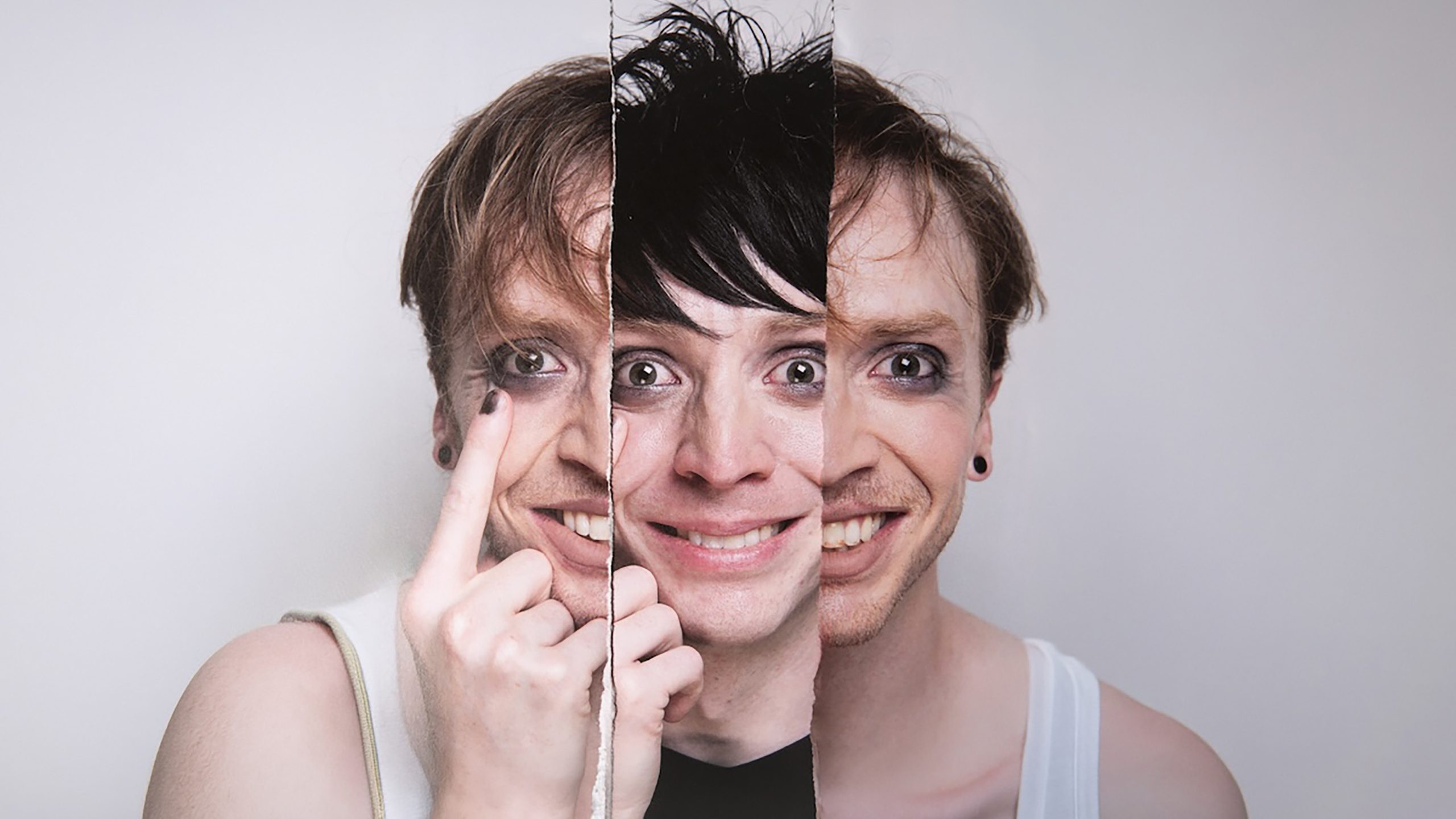
Image Credit: Derek in character for Goblin.
From suburban Chicago to London’s underground comedy circuit, Derek Mitchell has built a career on the strange, funny and sometimes unsettling business of being human. The Dutch-American actor, comedian and writer-performer first found his feet through teenage character performances before years of experimentation, unlikely gigs and digital storytelling led to Double Dutch, his viral comedy phenomenon reaching audiences worldwide. Along the way came acclaimed Fringe performances, a role in Ted Lasso and a growing reputation for comedy that gets beneath the surface of cultural identity.
But behind the characters is an artist asking bigger questions. “I feel like I’m only now really coming to understand what I actually believe,” Derek tells Run Riot. His work explores how we navigate different social realities, the identities we inherit and the people who shape us.
Now he’s bringing Goblin to Park Theatre, Finsbury Park, until 5 December 2026. Years in the making and entirely self-funded through his relentless stand-up touring, this award-winning, darkly comic solo show transports us to 2007, where a lonely queer teenager, his imaginary confidant and a dangerous relationship collide. Blending character comedy, psychological drama and audience participation, Goblin asks what happens when our hunger for love leaves us vulnerable.
There’s a wider urgency here, too. Derek passionately defends a cultural landscape where artists can create without personal wealth or institutional backing. “There are so many people who have something to say, who just aren’t in a position to self-fund their own work.”
So here’s your invitation: get yourself to Goblin, support an independent artist, then take Derek’s advice and discover London’s grassroots creative spaces. Catch experimental comedy at The Bill Murray, celebrate queer performance at The Divine, or champion intimate theatre at Waterloo East. Show up, take a chance, and help keep independent culture alive.
Derek, we’ve read about your childhood adventures in performance, from the church musical where you went to extraordinary lengths to make your costume convincing, to the high-school speech competitions that helped you discover your love of characters. But we’re curious about the years when things weren’t quite working out. Was there a particular failure, encounter or moment of unexpected encouragement that changed how you saw yourself as an artist, and what would you tell a young creative who’s still searching for their own voice?
I’ve always had a desire to perform and be perceived, which lots of people have. But the discipline and craft required to become a performer involves understanding what it is you have to offer while being perceived by others.
I developed an understanding of what I have to offer by making comedy content online. The world of digital content can be so brutal and unforgiving, because you’re in this attention marketplace that seemingly strips things of a sense of wonder or joy. But if you figure out a way to still make things in spite of that, you get an incredible window into the output that actually reaches people.
For me, that’s usually stuff rooted in my ability to see, feel and then channel the ways people experience the world: the social reality they take for granted, and what it means and costs to move between realities. This characterises almost all of my work online and it’s very much alive in Goblin.
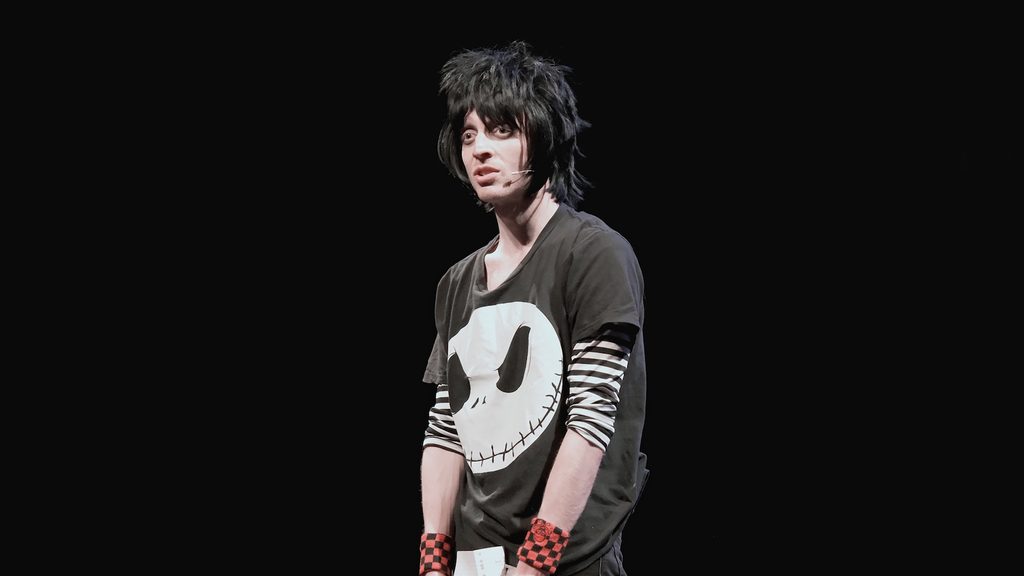
Image Credit: Derek in character for Goblin.
Goblin explores our desperate need to be seen, loved and understood. You’ve spoken movingly about growing up gay in suburban America, searching for people who reflected who you were. Looking back, what did that younger Derek most need to hear, and how much of him lives in Eliot?
I grew up in a family where there was a lot of love and I’m very lucky to have had that.
But what I yearned for was to be desired romantically. All the cultural messaging I consumed from a young age was that ending up with the love of your life is the ultimate goal. And the only type of love framed as legitimate was heterosexual love. The stories about queer love that I consumed I did so in secret, and they usually involved somebody dying of AIDS at the end.
So I was desperate to be desired and I pursued that at all costs, because it felt like the thing you were supposed to do to survive. That’s what Goblin is about.
What younger Derek most needed to hear was: don’t worry, it’s going to happen. Because I wasn’t sure it was – and that’s absolutely Eliot. That’s the way in which I am that character, or was that character.
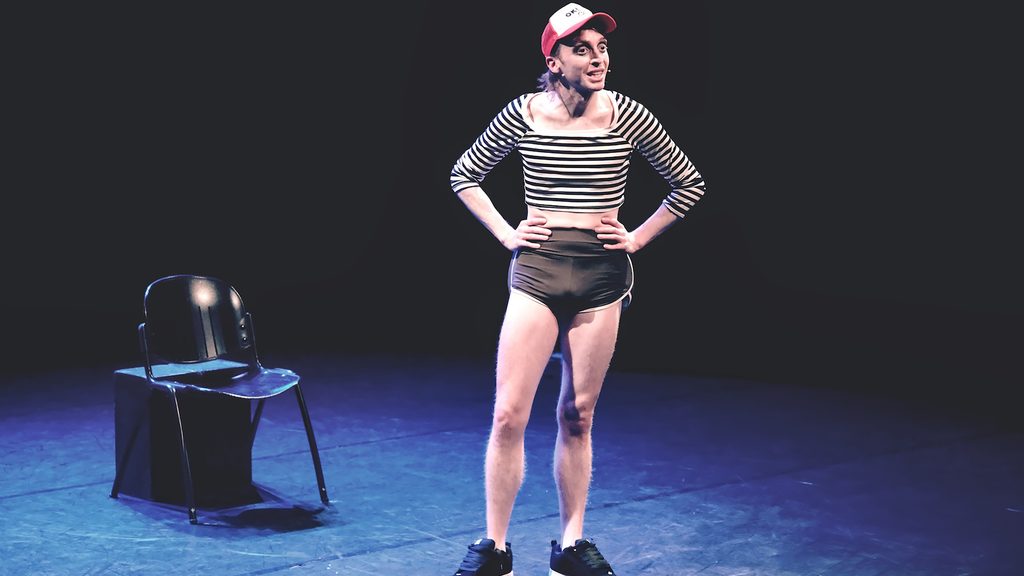
Image Credit: Derek in character for Goblin.
You’ve spent years moving between American, Dutch and British cultures, while making a living inhabiting other people’s identities. Has all that shapeshifting brought you closer to your true self, or occasionally made you wonder who that person actually is?
Yeah, definitely. I left the United States when I was 16 and ever since then I’ve lived in different places. I have a tendency to mirror, or acculturate to, the group and the language wherever I am, and I think that’s one of the reasons I like playing characters.
But there was also a period when I was totally susceptible to the ideas and ethics of the people around me. I think that’s just part of growing up. I feel like I’m only now really coming to understand what I actually believe.
But this is also what makes it dangerous for young people to fall under the sway of charismatic older people with nefarious motives. Those people know what they believe and what they want in a way that young people not only don’t, but aren’t even aware that they don’t. You don’t realise until much later that you were being shaped, rather than doing the shaping yourself.
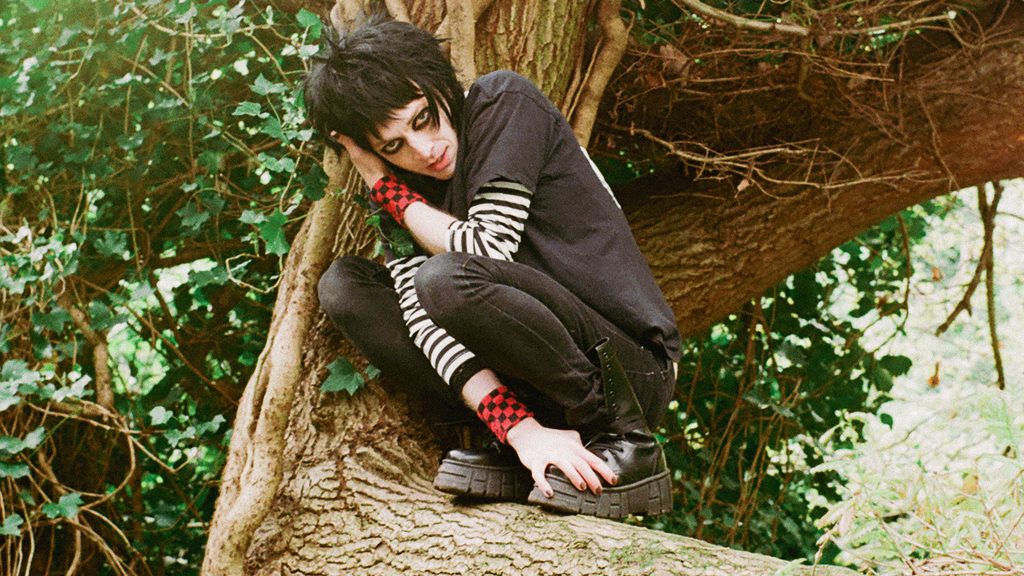
Image Credit: Derek in character for Goblin. Photographed by Michael Julings.
Goblin began life as a comedy about a villainous spin instructor and evolved into something considerably darker. You’ve said that laughter and darkness often come from the same place. When you’re creating work that explores exploitation, obsession and vulnerability, how do you decide when to make us laugh, when to make us uncomfortable, and when to leave us sitting with something we might rather avoid?
Toeing the line between laughter and darkness is one of the biggest dramaturgical tensions in this show, and Ellie BW, one of our two directors, was central in that negotiation.
Something that often gets lost in the discourse around what you’re allowed to say in comedy is that jokes are always saying something. Jokes are rhetorical: they’re making an argument. Of course, over-intellectualising comedy kills the funny – I totally agree with that. But for writers, performers and comedians, it’s our job to understand what it is we’re saying.
In the show, we make people laugh while we’re building a rapport between the protagonist and the audience, who play Goblin: the protagonist’s imaginary friend and conscience. As the protagonist becomes more dislocated from Goblin and more lost in his life, it becomes harder for the audience to keep laughing. That’s a really interesting thing to see happening in real time.
We’ve also been quite surgical about the jokes at specific points in the drama, because sometimes the audience is supposed to think: yes, this is a joke, but we almost don’t feel safe laughing at it anymore. But those jokes can’t feel like a drastic departure from where the character is emotionally – they still have to feel dramatically embedded and earned. So there were a lot of plates to keep spinning.
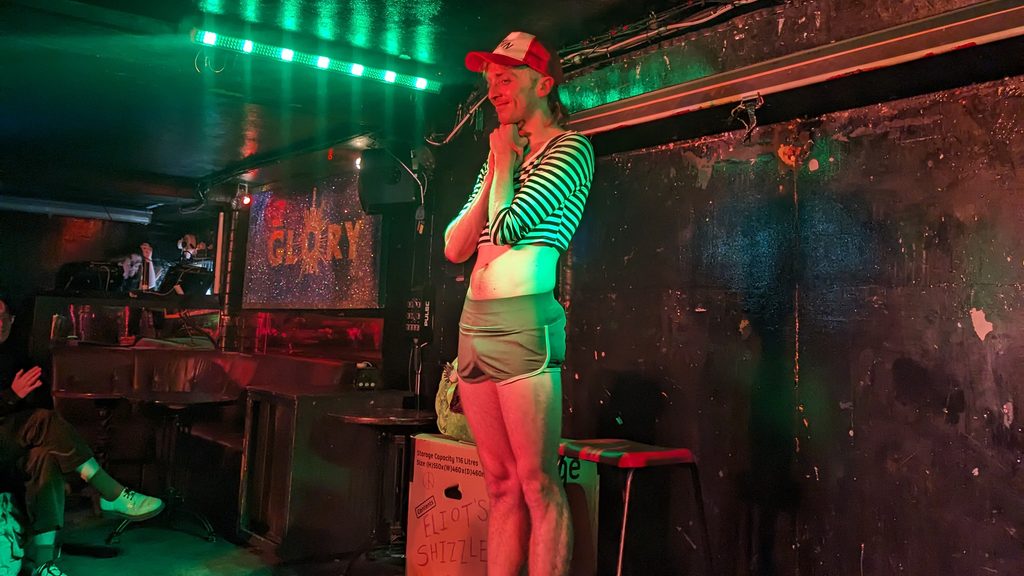
Image Credit: Derek in character for Goblin, performing at The Glory.
There’s something deliciously unsettling about making the audience Eliot’s imaginary friend. We’re invited to become his confidant, yet we’re powerless to intervene as his world unravels. What discoveries have surprised you during Goblin‘s long development, and has the experience changed your understanding of what an audience owes the characters, or perhaps the people, whose lives they’re witnessing?
This has been one of the biggest research journeys in developing the show. In the beginning, ‘Goblin’ was actually a character on stage, and that always felt kind of hokey. Then we cracked the audience being the goblin through our work with Ben Target, the wonderful writer-performer, and from there everything started falling into place.
But it still took us over a year to move away from a choose-your-own-adventure dynamic. In retrospect it’s obvious why that completely curtailed the dramatic stakes. It felt like a childish game of deciding which of two choices the protagonist would make.
What we ultimately learned is that the stakes are heightened when what’s going to happen feels a little bit out of the audience’s control, and yet they’re still there bearing witness to everything, whether they want to be or not. Because that is what it feels like to see someone get lost to circumstances that increasingly exist outside of their own control.
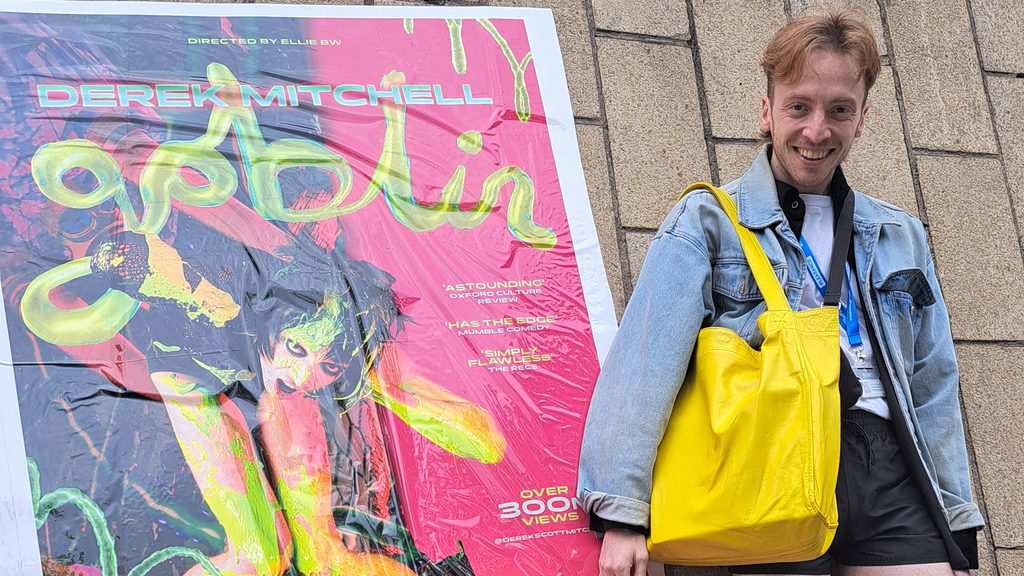
Image Credit: Derek at the Edinburgh Fringe.
You’ve experienced the creative worlds of Chicago, Amsterdam and London, and you’ve spoken about the privilege of having the resources to pursue an artistic career. Looking at the UK today, where talent and ambition don’t always come with financial security, what would you most like to change about our creative industries, and what gives you hope for their future?
I can really only speak for comedy and theatre. But a cultural sector where the production of artistic work is totally determined by market forces, as subsidy is increasingly scrapped, is such a different way of doing things. I’ve always believed in the vision of a subsidised cultural sector in western Europe, which existed in force from the post-war period up until the last couple of decades.
I’ve self-produced Goblin financially from the beginning. Now I’m working with Chris Darby and Daddy’s Money Productions, and it’s a wonderful gift to have him on board for this run. But the development of the show was funded totally privately, using money I made from touring stand-up more or less nonstop for the past three years. There’s rarely, if ever, been a moment of creative pause.
I’m in a very lucky position to have the money to make things, and I don’t think I’m uniquely deserving of that. There are so many people who have something to say, who just aren’t in a position to self-fund their own work. Increasingly, there’s all kinds of interesting work that simply won’t get made. It would be a sad day in the United Kingdom if it’s not possible to make work without having money or the backing of an important institution.
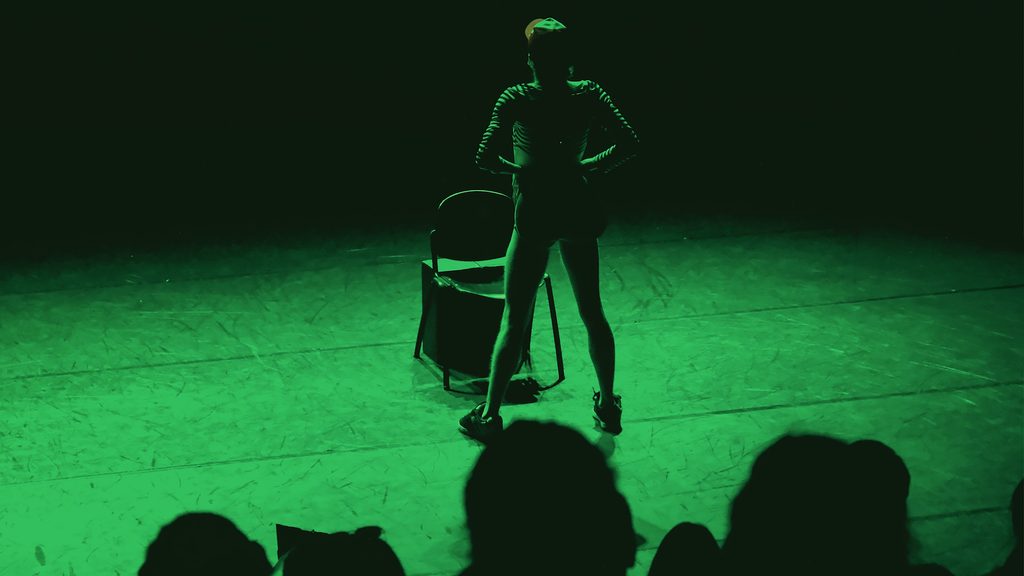
Image Credit: Derek in character for Goblin.
Finally, take us off the beaten track. Which three cultural places in London hold a special place in your heart, and why should our readers seek them out?
The Divine – a bar and queer performance venue in Stoke Newington, the new project from a wonderful team including Jonny Woo, whose first iteration was The Glory. My first flat in London was around the corner from The Glory, and it was the first place I really did comedy frequently in London. They’re the most supportive of artists of almost any venue I know, and it was a key part of my first couple of years in London.
The Bill Murray – I think it’s the best comedy venue in London, and it’s where I did one of the earliest work-in-progress outings of Goblin. Literally any day of the week you can buy a ticket and see some of the best comedians in the UK testing new material. It’s one of the best places for comedy in the world, I think.
Waterloo East Theatre – I’m so excited to be doing this show at the Park, but one of the most special theatres in London for me is the Waterloo East Theatre, a small theatre where I did my first ever full-length run of a play. I did eight shows a week for about three months there. Getting to perform a play every day, and get paid to do it, was one of the most artistically gratifying experiences of my life. It was the first time I ever really felt like: I’m really doing this.
Find Derek Mitchell @derekscottmitchell
See Derek’s work IRL → parktheatre.co.uk
Goblin
Park Theatre
Clifton Terrace
Finsbury Park
London N4 3JP
Until 5 Dec 2026
Tickets & info → parktheatre.co.uk