
Michael Zandl on FOOD: Laughing at a World That Can’t Stop Consuming
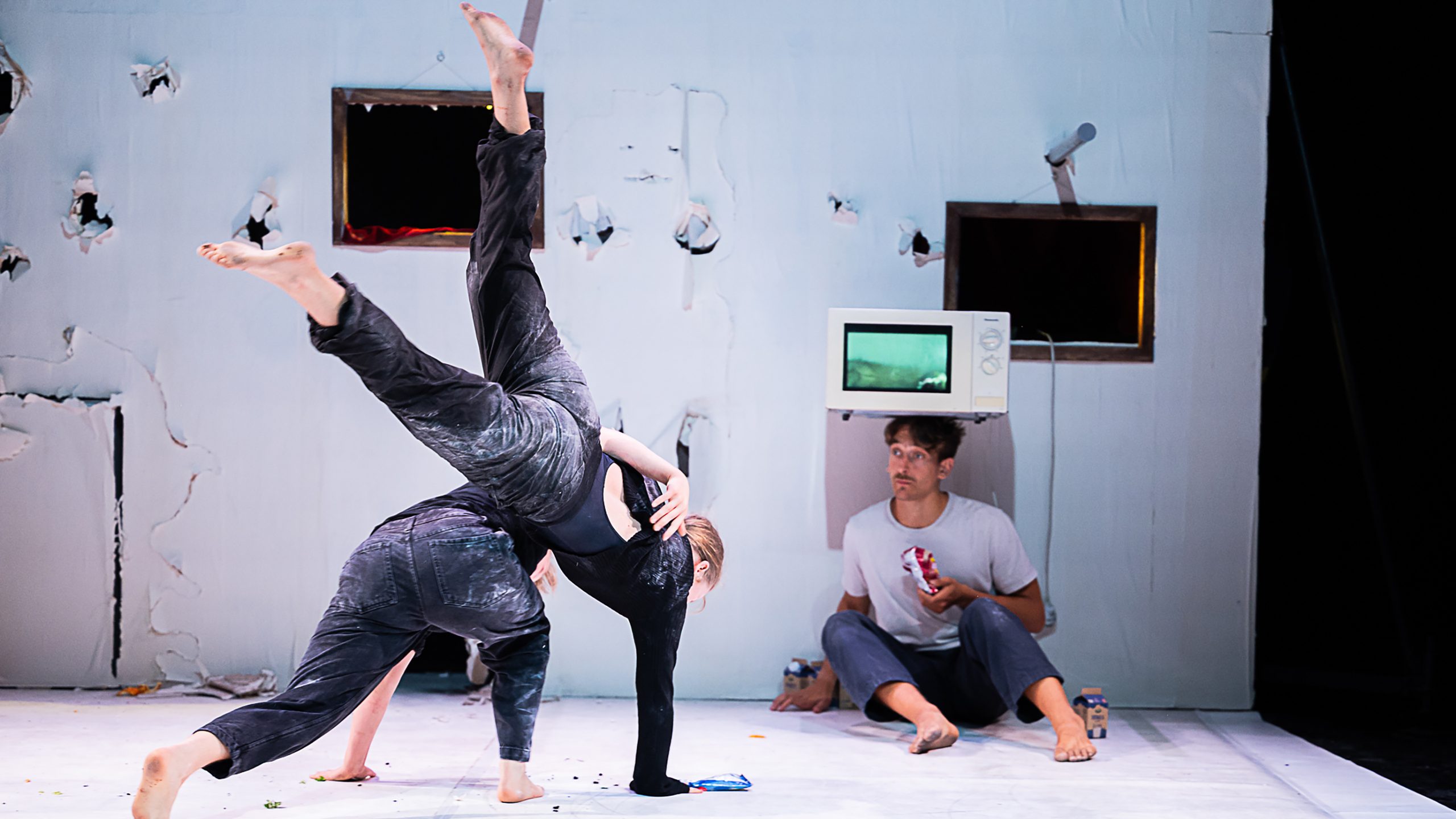
Image Credit: ‘FOOD’ by Michael Zandl, photographed by Cosmin Cirstea.
From juggling in a small village in the Austrian Alps to reinventing the possibilities of contemporary circus, Michael Zandl has followed an unconventional path, guided by curiosity, imagination and the joy of making things together.
After studying agricultural science in Vienna, Michael traded the prospect of a conventional career for circus training in Rotterdam. The turning point came when he joined a group of enthusiastic amateurs to create a full-length performance. The experience was chaotic, exhausting and exhilarating. As he tells Run Riot, “I think juggling was what first brought me into the circus world, but it is the warm-hearted community that has kept me here.”
Since then, Michael has established an acclaimed international career, creating the surreal solo work Janus and co-founding Sawdust Symphony, where carpentry, craftsmanship and circus collide. His work transforms everyday objects into extraordinary theatrical encounters, combining physical virtuosity, ingenious stagecraft and a wonderfully absurd sense of humour.
Now he brings FOOD to London’s Southbank Centre, presented with support from MimeLondon, from 13–17 January 2027. His first production as director, FOOD brings together four exceptional circus artists – Fidel Rott, Jakob Vöckler, and twins Karin and Hedvig Brodén – in a surreal exploration of appetite, excess and the mechanisms of the food industry.
Inspired by Marco Ferreri’s grotesque cinematic satire La Grande Bouffe, the production examines the contradictions of a world where abundance and inequality coexist, and where consumption so often exceeds our needs.
Rather than preaching, Michael invites us to laugh, feel uncomfortable and question what we’ve witnessed. “For me, humour creates a certain openness. When people laugh, they become more receptive and perhaps a little less defensive.”
It’s a philosophy that extends beyond the stage: stay curious, make space for others and approach difficult questions with imagination.
So, come hungry for something unexpected. See FOOD, share a meal with friends, support your local food-sharing initiative, or try making something wonderful from what you already have. A little less waste, a little more creativity, and perhaps a different appetite for life.
You grew up in the Austrian Alps, studied agricultural science in Vienna, and seemed to be heading towards a very different future before choosing circus. Was there a particular moment when the pull of making art became impossible to ignore? Looking back, what did that leap into the unknown teach you about trusting your instincts?
I think the transition was probably less sudden than it might look from the outside. I grew up in a very small village, in quite a different environment from the artistic world I eventually found myself in. When I moved to Vienna to study agricultural science, I didn’t necessarily have a very clear idea of what I wanted to do with my life. I was following a path that seemed quite reasonable at the time.
I had actually started juggling at a young age, but over the years this interest gradually grew. I began attending juggling conventions, where I was introduced to performance art and contemporary circus for the first time. I became quite fascinated by this world and started combining regular, intensive training with my first tiny performances.
At some point, together with a large group of very enthusiastic amateurs, we decided to create a full-length show together in Vienna. This was quite an adventure, as you can imagine. The whole process was chaotic and exhausting, but also incredibly exciting and unique. I think this was the moment when I really fell in love with the process of creating performances and also with the supportive community around it.
That’s when I started thinking that perhaps I could actually make circus my profession. I decided to give it a chance, finished my studies in Vienna and applied to a circus school in Rotterdam.
It turned out to be a decision I have never regretted.
Looking back, I think juggling was what first brought me into the circus world, but it is the warm-hearted community that has kept me here.
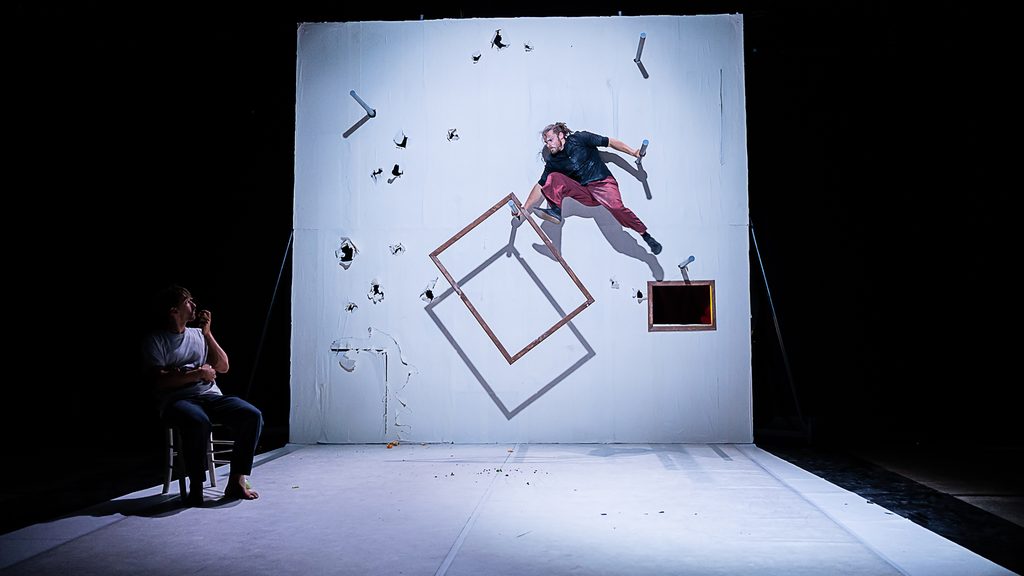
Image Credit: ‘FOOD’ by Michael Zandl, photographed by Cosmin Cirstea.
You’ve spoken about feeling physically sick after watching Marco Ferreri’s La Grande Bouffe, which helped inspire FOOD. What was it about that experience that stayed with you? We’re living in a world of extraordinary abundance and profound inequality, where our appetites are constantly being encouraged. Has making FOOD changed how you understand your own desires, or the systems that shape them?
The initial idea for FOOD came from watching the movie La Grande Bouffe by Marco Ferreri. I remember that I felt physically stuffed and almost sick after watching it, even though I hadn’t eaten a single bite. I found it fascinating that visual input alone could have such a strong physical effect on me.
The film also presents a very interesting and absurd situation: four wealthy friends who have everything they could possibly want, but are so bored with their lives that they decide to eat themselves to death. I found this combination of abundance, boredom and excess very fascinating and felt that there was a lot of potential for a performance.
Initially, we wanted to create a piece about human consumption in general, using food as a metaphor for the way we consume. But we quickly realised that this topic was simply too broad. So we decided to focus on food itself, its history, our relationship with it, and especially some of the absurd and disturbing mechanisms of the food industry.
I wouldn’t say that making FOOD has fundamentally changed my own relationship with food or my desires. But researching the subject certainly made me more aware of the systems behind the things we consume and how complex the food industry actually is.
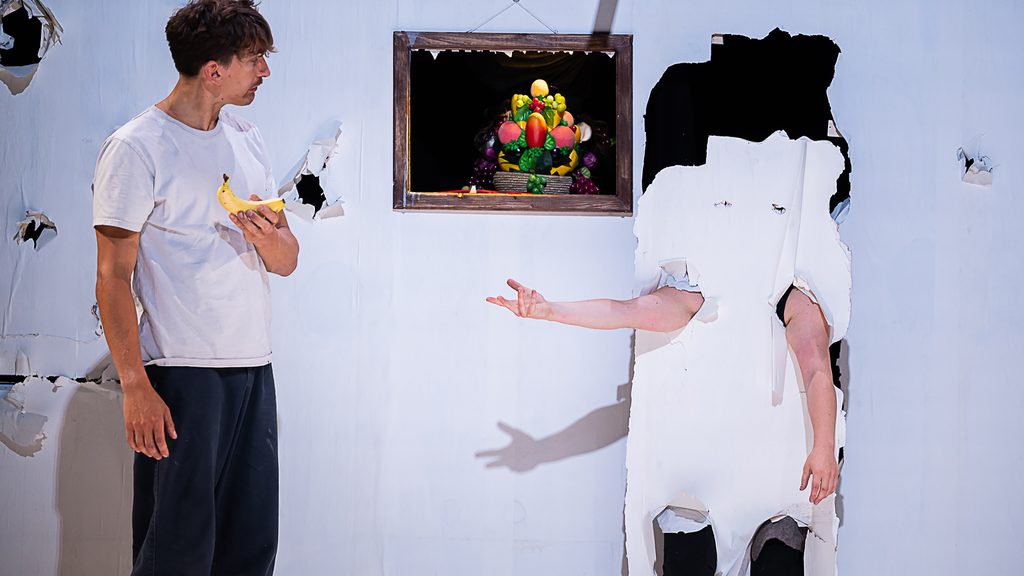
Image Credit: ‘FOOD’ by Michael Zandl, photographed by Cosmin Cirstea.
There’s something wonderfully subversive about using laughter to explore uncomfortable truths. Do you think absurdity can reach people in ways that more direct political commentary cannot?
I think humour and absurdity are incredibly powerful tools, especially when dealing with uncomfortable subjects. There is something interesting about the fact that people can sometimes laugh at things they would find difficult to engage with in a more serious context.
For me, humour creates a certain openness. When people laugh, they become more receptive and perhaps a little less defensive.
It can also create a very interesting contrast: you make someone laugh, and then suddenly something happens that makes them feel uncomfortable or even question what they were laughing about in the first place.
I am not particularly interested in making performances that explain things or tell the audience what to think. I much prefer creating situations and images that people can interpret in their own way.
Absurdity is very useful for this because it allows you to exaggerate something until its underlying logic becomes visible.
I also think that humour can sometimes reveal the absurdity of reality more effectively than a direct critique. Especially with a subject like the food industry, there are situations that are so strange and contradictory that you almost don’t need to exaggerate them very much.
In FOOD, I enjoy moving between moments that are funny, beautiful, surprising and sometimes quite disturbing. For me, this mixture is much more interesting than maintaining one particular tone throughout the performance.
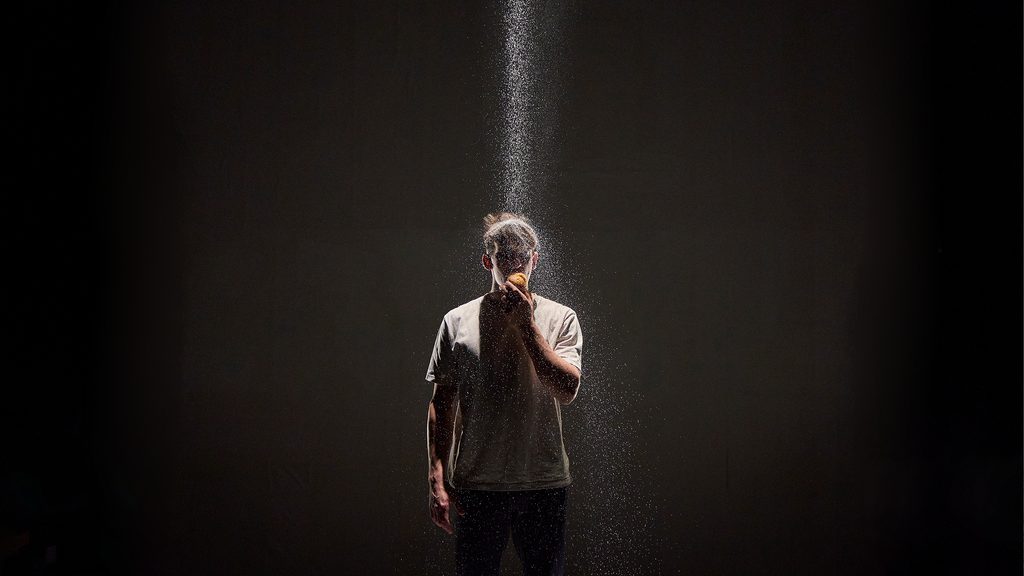
Image Credit: ‘FOOD’ by Michael Zandl, photographed by Jona Harnischmacher.
FOOD marks a shift from performing to directing, working with four remarkable circus artists – Fidel Rott, Jakob Vöckler, and twins Karin and Hedvig Brodén. Your productions also have a wonderful relationship with objects, machinery and illusion. How did the different personalities and physical languages of your collaborators shape the work, and what surprised you most about handing over the stage to others?
FOOD was the first time I created a performance without being on stage myself. It was a very new experience, and one that I really enjoyed, although it also required me to rethink my role in the creative process.
It was important for me to work with people I trusted and genuinely enjoyed spending time with. I didn’t want to simply assemble a group of technically strong performers. I wanted to bring together artists with different personalities, sensibilities and ways of approaching performing and circus.
Fidel, Jakob, Karin and Hedvig each brought their own ideas, experiences and artistic languages into the process. Rather than having a fixed story or choreography that I wanted them to execute, I tried to create an environment in which everyone could contribute and become a co-author of the piece.
I think this is particularly important when working with circus artists, because everyone has a very individual relationship with their body, their skills, the objects they manipulate and with being on stage. Sometimes an idea that works beautifully for one person makes no sense for another, and I find it much more interesting to explore these differences than to try to make everyone work in the same way.
My role was mainly to give impulses, propose tasks, ask questions and guide the process when interesting things started to emerge. At the same time, I had to keep an overview and gradually bring all these individual discoveries together into one coherent performance.
One thing I particularly enjoyed was being able to watch the work from the outside. As a performer, you are usually very much inside the action, whereas as a director you can observe the relationships between the performers, the objects, the scenography and the audience.
I have to say that I really enjoy having the opportunity and privilege of experiencing our show from the audience’s perspective. Since I also tour with the show as a technician, I still feel very much connected to the performers and the whole performance. In a way, I continue to feel like I’m part of the show, just from a different position.
At the same time, I’m also happy to still be on stage in Sawdust Symphony, another production I’m currently touring with.
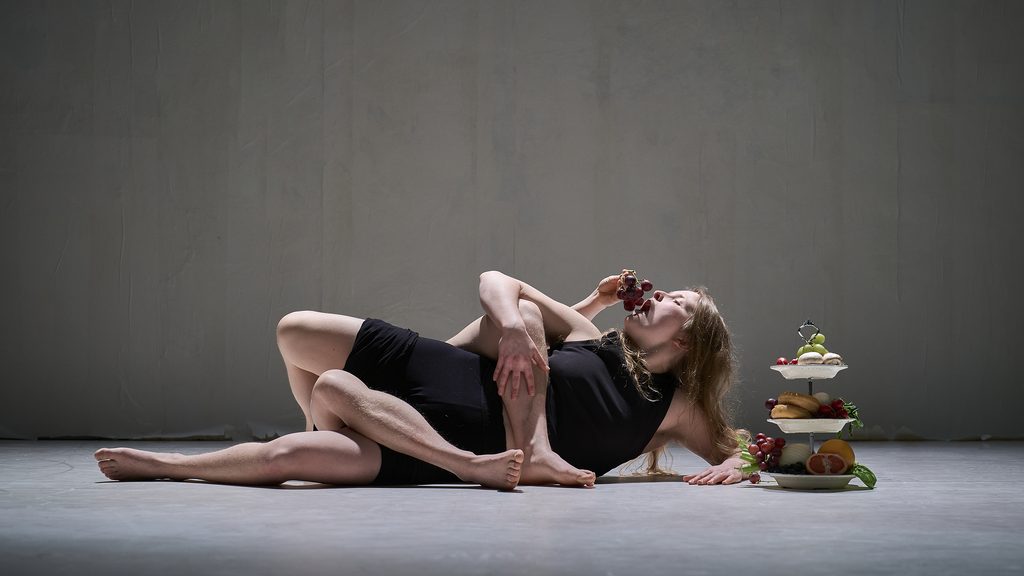
Image Credit: ‘FOOD’ by Michael Zandl, photographed by Jona Harnischmacher.
MimeLondon has a remarkable history of introducing international artists to London audiences, often challenging our expectations of what theatre can be. As FOOD makes its UK premiere at the Southbank Centre, what excites you about sharing the work with a new audience, and what do you hope people might carry away from the experience?
I am very excited about bringing FOOD to London, especially because it is a city with such a rich and diverse cultural scene.
I’ve toured the UK with other productions before, and I have to say that we’ve always encountered incredibly generous audiences wherever we’ve performed. It’s always a pleasure to perform for an audience that is open, engaged and genuinely enjoys what they’re experiencing.
Ultimately, I would love people to go out of the theatre with a feeling that they have experienced something unexpected, that they might need to digest for a bit. Perhaps they will look at their next meal a little differently, or simply find themselves thinking about the performance again a few days later.
For me, the biggest compliment is to see the audience laugh, feel moved and sometimes even shudder during the same performance. And when they leave the theatre, I hope they think: “Wow… I’ve never seen anything like that before.”
Find Michael at michaelzandl.com and on Insta @michael.zandl
See Michael’s work IRL → southbankcentre.co.uk
MimeLondon: FOOD
Southbank Centre
Wed 13 Jan – Sun 17 Jan 2027, 19:45 (Sat: 17:00, Sun: 14:30)
Tickets and info → southbankcentre.co.uk
Concept/director: Michael Zandl
Artists/co-authors: Fidel Rott, Hedvig Brodén, Jakob Vöckler & Karin Brodén
Artistic advice: Dennis Molendijk
Outside eye: Sara Sguotti, Ariane Oechsner, Arne Mannott
Sound design: Victor Maillard
Light design: Lisette van der Linden
Stage design and effects: Michael Zandl
Costumes: Germain Charlat
Production: Mirjam Zwanenburg (Korzo)
Producer: Korzo
Funded by: Bondsministerie Republiek Oostenrijk, Ministerie van OC&W NL, Stad Den Haag
Co-producers: Perplx, Winterfest Salzburg, Circuswerkplaats Dommelhof & CirkLabo
Photos: © Jona Harnischmacher and Cosmin Cirstea
Presented by the Southbank Centre
Supported by MimeLondon